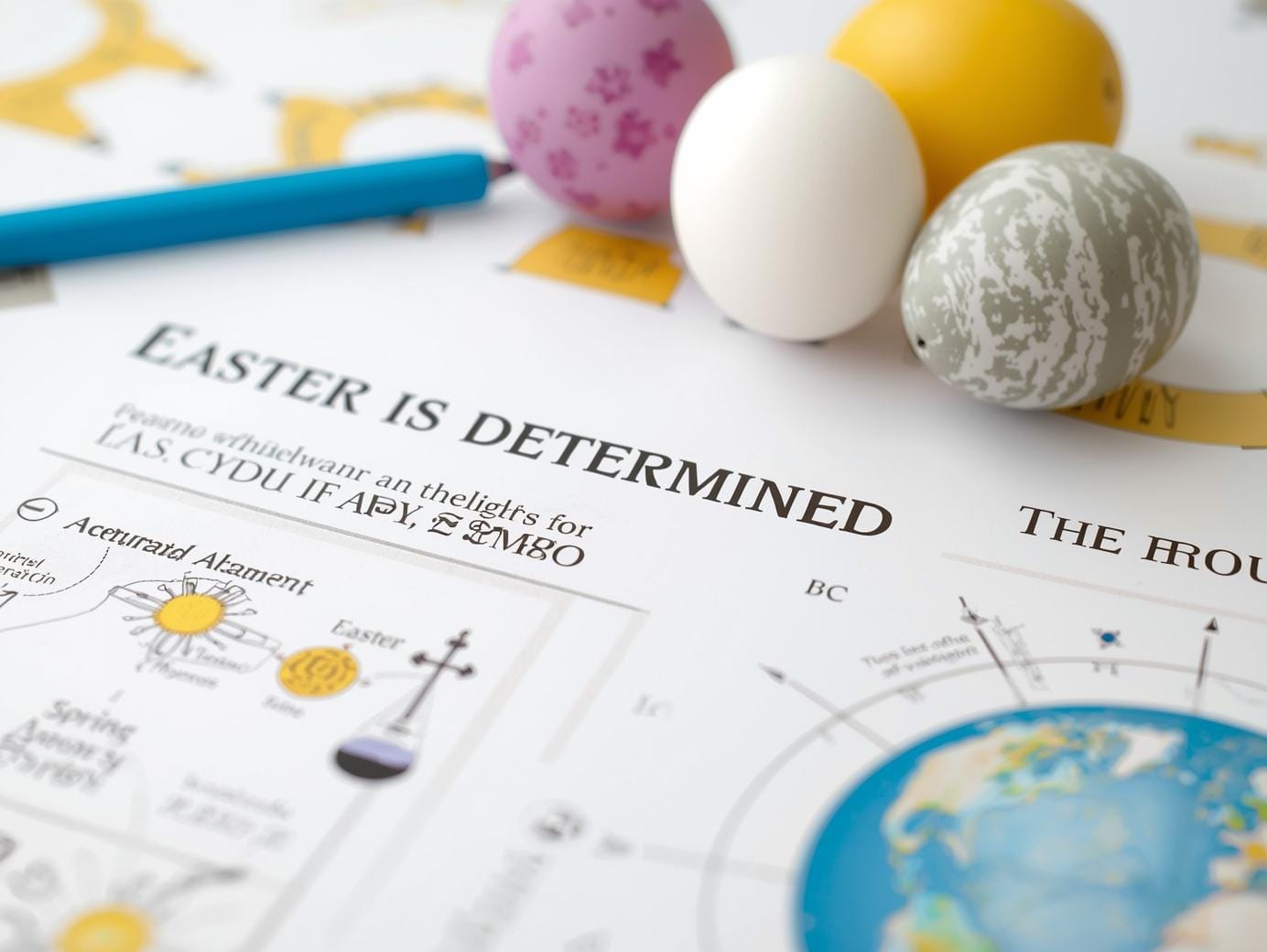
Have you ever wondered why Easter jumps around the calendar like a bunny on a spring morning? One year it’s in late March, the next it’s pushing into late April. Unlike Christmas, which reliably shows up on December 25th every year, Easter seems to play by its own rules. So, how is Easter determined, and why does this important Christian holiday refuse to stay put?
The answer is actually quite fascinating and takes us on a journey through ancient astronomy, religious tradition, and even a bit of mathematical calculation. Understanding how is Easter determined connects us to centuries of human observation of the heavens and the desire to align religious celebrations with the natural world around us.
In this comprehensive guide, we’ll explore everything you need to know about Easter’s date calculation, from the lunar cycles that govern it to the historical decisions that shaped how we celebrate it today. Whether you’re simply curious or planning ahead for family gatherings, you’ll finally understand the method behind what might seem like madness.
Table of Contents
| Sr# | Headings |
|---|---|
| 1 | The Basic Rule: Easter and the Spring Equinox |
| 2 | Understanding the Paschal Full Moon |
| 3 | Why Does Easter Move Around Each Year? |
| 4 | The Historical Origins of Easter’s Date Calculation |
| 5 | The Council of Nicaea and the Easter Controversy |
| 6 | How Western Christianity Calculates Easter |
| 7 | Eastern Orthodox Easter: A Different Calendar, A Different Date |
| 8 | The Gregorian Calendar Reform and Its Impact |
| 9 | The Earliest and Latest Possible Easter Dates |
| 10 | The Mathematical Formula Behind Easter |
| 11 | Why Doesn’t Easter Follow the Jewish Passover Exactly? |
| 12 | The Astronomical vs. Ecclesiastical Full Moon |
| 13 | How Other Christian Holidays Depend on Easter |
| 14 | Modern Proposals to Fix Easter’s Date |
| 15 | The Cultural and Practical Impact of Easter’s Moving Date |
1. The Basic Rule: Easter and the Spring Equinox
Let’s start with the simple version of how is Easter determined: Easter falls on the first Sunday after the first full moon occurring on or after the spring equinox. Think of it like a cosmic recipe with three key ingredients: the spring equinox, a full moon, and a Sunday.
But why these three elements? Each carries deep significance. The spring equinox (around March 20-21 in the Northern Hemisphere) represents rebirth and renewal—perfectly symbolizing resurrection themes. The full moon connects Easter to its Jewish roots in Passover, which follows a lunar calendar. And Sunday? That’s the day Christians believe Jesus rose from the dead.
Here’s where it gets interesting: the spring equinox we’re talking about isn’t necessarily the actual astronomical equinox. Instead, the church uses a fixed date of March 21st for calculation purposes. This ecclesiastical equinox doesn’t always match when Earth’s axis is truly perpendicular to the sun’s rays, but it keeps things consistent.
So if the first full moon after March 21st falls on a Saturday, Easter is the following Sunday. If it falls on a Sunday itself, that Sunday is Easter. It’s like waiting for all the tumblers in a cosmic lock to align before the celebration can begin.
2. Understanding the Paschal Full Moon
The term “Paschal Full Moon” might sound like something out of a medieval astronomy textbook, but it’s central to understanding how is Easter determined. “Paschal” comes from “Pascha,” which relates to Passover, connecting Easter to its Jewish heritage.
The Paschal Full Moon is defined as the first ecclesiastical full moon that occurs on or after March 21st. Notice I said “ecclesiastical” full moon—this is crucial. The church doesn’t necessarily use the actual astronomical full moon you see in the sky. Instead, they use a calculated full moon based on historical lunar tables.
Why the disconnect from reality? Consistency and simplicity. In the 6th century, when these rules were being formalized, accurately predicting the exact moment of a full moon for churches scattered across Europe, Africa, and Asia was nearly impossible. Different regions would calculate different dates, creating chaos for a unified celebration.
The solution was to create standardized lunar tables that approximated the moon’s phases. These tables follow a 19-year cycle called the Metonic cycle, which ancient astronomers discovered: after 19 years, the phases of the moon occur on approximately the same calendar dates again. It’s like the moon has a memory that lasts nearly two decades!
3. Why Does Easter Move Around Each Year?
If you’ve ever tried to plan a spring vacation or schedule an event, you’ve probably cursed Easter’s wandering ways. But why does Easter move around each year while other holidays stay put?
The answer lies in the collision of two different time-keeping systems: the solar calendar (which governs our standard year) and the lunar calendar (which governed much of ancient religious life). Our modern calendar follows the sun, with years of 365 days (plus a leap day). But lunar months are about 29.5 days long, meaning 12 lunar months only add up to about 354 days.
These two cycles are like dancers moving to different rhythms. They occasionally sync up, but most of the time, they’re out of step. Since Easter depends on both a solar event (the spring equinox) and a lunar event (the full moon), it has to dance with both partners. The result? Easter can fall anywhere between March 22nd and April 25th—a range of 35 possible dates.
Think of it this way: if Easter were a train, it would be running on tracks that shift slightly every year, always heading in the same direction but never pulling into the station on quite the same day.
4. The Historical Origins of Easter’s Date Calculation
To truly understand how is Easter determined, we need to hop in a time machine and travel back to the early days of Christianity. The very first Christians were Jews who continued to observe Passover but gave it new meaning through the lens of Jesus’s death and resurrection.
The earliest Easter celebrations actually coincided with Passover, which follows the Jewish lunar calendar. Some Christian communities, particularly in Asia Minor, celebrated Easter on the 14th day of the Jewish month of Nisan, regardless of what day of the week it fell on. These were called Quartodecimans (from the Latin for “fourteenth”).
However, other Christian communities, especially in Rome, insisted that Easter should always be celebrated on a Sunday—the day of resurrection. This wasn’t just liturgical preference; it was about establishing a distinct Christian identity separate from Judaism.
This disagreement created significant tension. Imagine traveling to visit fellow Christians only to discover they celebrated Easter on a completely different day—or worse, had already finished celebrating! It would be like showing up for Thanksgiving dinner a week late.
The debate raged for centuries until church leaders decided something had to give.
5. The Council of Nicaea and the Easter Controversy
In 325 CE, Emperor Constantine convened the Council of Nicaea, one of the most significant gatherings in Christian history. While the council is famous for establishing orthodox beliefs about the nature of Christ, it also tackled the practical problem of how is Easter determined.
The council made several crucial decisions:
1. Easter must be celebrated on a Sunday (sorry, Quartodecimans)
2. The date should be calculated independently from the Jewish calendar (to establish Christian autonomy)
3. All Christians should celebrate Easter on the same day (for unity)
4. The celebration should fall after the spring equinox (connecting to rebirth symbolism)
However—and this is important—the council didn’t create a specific mathematical formula. Instead, it established the principles, leaving the detailed calculations to be worked out later. It’s like they drew the blueprint but left the engineering to others.
The church in Alexandria, Egypt, renowned for its astronomical and mathematical expertise, became responsible for calculating Easter dates and informing other churches. For centuries, the Alexandrian calculation method, eventually refined by monk Dionysius Exiguus in the 6th century, determined when Christians celebrated Easter.
6. How Western Christianity Calculates Easter
For Western Christians (Catholics, Protestants, and others following the Gregorian calendar), the modern method of how is Easter determined uses a complex but consistent algorithm. Here’s how it works in practice:
Step 1: Start with March 21st as the ecclesiastical spring equinox (even if the astronomical equinox falls on a different day).
Step 2: Find the date of the Paschal Full Moon—the first ecclesiastical full moon on or after March 21st. Churches use pre-calculated tables based on the 19-year Metonic cycle rather than observing the actual moon.
Step 3: Easter Sunday is the first Sunday following this Paschal Full Moon. If the Paschal Full Moon falls on a Sunday, Easter is that very Sunday.
Let me give you a concrete example: In 2024, March 21st falls on a Thursday. The first full moon after that date occurs on March 25th (Monday). The first Sunday after March 25th is March 31st—and that’s Easter Sunday 2024.
The system uses something called “epacts”—numbers that track where we are in the 19-year lunar cycle. It also accounts for the Gregorian calendar’s leap year adjustments. Don’t worry if this sounds complicated—even many church officials use published Easter tables rather than calculating from scratch!
7. Eastern Orthodox Easter: A Different Calendar, A Different Date
Here’s where things get even more interesting. If you have Orthodox Christian friends, you’ve probably noticed they often celebrate Easter on a different date than Western Christians. This isn’t because they follow different theological principles for how is Easter determined—they use the same basic formula. The difference lies in which calendar they use.
Western churches adopted the Gregorian calendar in 1582, which Pope Gregory XIII introduced to correct accumulated errors in the older Julian calendar. This more accurately aligns the calendar year with Earth’s orbit around the sun.
Eastern Orthodox churches still use the Julian calendar for calculating Easter (though many use the Gregorian calendar for fixed holidays like Christmas). The Julian calendar is now 13 days behind the Gregorian calendar, and this gap increases by three days every four centuries.
Additionally, Orthodox churches follow an extra rule: Easter must come after Passover. This maintains the historical sequence of events (Jesus’s crucifixion happened during Passover).
The result? Orthodox Easter can fall anywhere from one to five weeks after Western Easter, though occasionally they coincide. In years when both traditions celebrate together, it’s a beautiful moment of unity. It’s like two trains running on parallel tracks that occasionally pull into the station at the same time.
8. The Gregorian Calendar Reform and Its Impact
In 1582, Pope Gregory XIII recognized a serious problem: the Julian calendar was drifting. By the 16th century, the calendar was about 10 days out of sync with the seasons. The spring equinox, once reliably around March 21st, was creeping earlier in the calendar.
This threatened the Easter calculation system. If left uncorrected, eventually Easter would drift into winter! The Gregorian reform made two key changes:
1. Immediate correction: Ten days were dropped from the calendar (October 4, 1582 was followed by October 15, 1582). Imagine going to bed on Thursday and waking up on Friday—nearly two weeks later!
2. Leap year adjustment: The rule became that century years (1700, 1800, 1900) are not leap years unless divisible by 400. This subtle change keeps the calendar accurate to within one day every 3,236 years.
For Easter calculation purposes, the Gregorian reform also refined the lunar tables used to determine the Paschal Full Moon, making them more accurate.
However, not everyone adopted the new calendar immediately. Protestant countries were suspicious of this “Catholic” calendar and waited decades or even centuries. Britain and its colonies (including America) didn’t switch until 1752. Orthodox countries waited even longer—Russia didn’t adopt it until 1918!
This created centuries of confusion about how is Easter determined, with different Christian communities celebrating on different dates even within the same country.
9. The Earliest and Latest Possible Easter Dates
One of the most fascinating aspects of how is Easter determined is understanding its boundaries. Easter doesn’t wander randomly—it operates within specific limits.
The earliest possible Easter is March 22nd. This rare occurrence happens when the Paschal Full Moon falls on March 21st (the ecclesiastical equinox) and that day is a Saturday, making the next day, Sunday March 22nd, Easter. The last time this happened was in 1818, and it won’t happen again until 2285. If you’re planning to witness it, you might want to invest in cryogenic preservation!
The latest possible Easter is April 25th. This happens when the Paschal Full Moon falls on April 18th and that day is a Sunday, pushing Easter to the following Sunday. This last occurred in 1943 and won’t happen again until 2038.
Most Easters fall somewhere in the middle of this range, clustering around early to mid-April. There’s even a phenomenon called “Easter cycle”—the full pattern of Easter dates repeats every 5.7 million years! This staggering number results from the complex interaction of the solar year, lunar cycles, and the seven-day week.
The span of 35 possible dates means Easter is like a VIP guest who shows up when they want, keeping party planners, school schedulers, and vacation planners on their toes every year.
10. The Mathematical Formula Behind Easter
For those who love numbers, how is Easter determined can be expressed through mathematical formulas. The most famous is the Computus—a collection of algorithms developed over centuries to calculate Easter dates.
The formula used for the Gregorian calendar (post-1583) involves several steps:
Step 1: Calculate the “Golden Number” (your position in the 19-year Metonic cycle): (Year mod 19) + 1
Step 2: Determine the “Epact” (the moon’s age on January 1st)
Step 3: Find the “Paschal Full Moon” date using the epact
Step 4: Calculate the following Sunday
German mathematician Carl Friedrich Gauss developed a famous algorithm in 1800 that can calculate Easter for any year. Here’s a simplified version:
- Let Y = the year
- Calculate several intermediate values involving division and remainders
- Apply corrections for the century
- Determine the month and day
Computer programmers love this problem because it combines calendar mathematics, modular arithmetic, and ancient astronomy. It’s like a puzzle that bridges the ancient and modern worlds.
However, most people simply look up Easter dates in published tables or use online calculators. After all, you don’t need to understand how your car engine works to drive to the grocery store!
11. Why Doesn’t Easter Follow the Jewish Passover Exactly?
Since Jesus’s crucifixion and resurrection occurred during Passover, you might wonder why how is Easter determined doesn’t simply follow the Jewish calendar. The answer involves both theological and historical factors.
Early Christianity’s separation from Judaism played a significant role. By the 4th century, church leaders wanted Christian celebrations to be distinct and independent. The Council of Nicaea explicitly stated that Easter should be calculated without reference to Jewish authorities who determined Passover dates.
There are also calendar differences. The Jewish calendar is purely lunar, with months strictly following moon phases and occasional leap months added to keep holidays in their proper seasons. The Christian calculation uses an ecclesiastical approximation of lunar cycles grafted onto the solar Gregorian calendar—a hybrid system.
Additionally, the requirement that Easter must fall on Sunday automatically separates it from Passover, which can fall on any day of the week.
Despite these differences, Easter and Passover often occur near each other, sometimes overlapping. This proximity reminds us of the shared heritage—Christianity emerged from Jewish soil, and understanding one helps illuminate the other. They’re like branches from the same historical tree, growing in different directions but connected at the root.
12. The Astronomical vs. Ecclesiastical Full Moon
Here’s a detail that puzzles many people learning how is Easter determined: sometimes the “official” Easter calculation uses a full moon date that doesn’t match the actual full moon you see in the sky. What gives?
The astronomical full moon is the actual moment when the moon is directly opposite the sun, fully illuminated from Earth’s perspective. This can be calculated with extreme precision—down to the minute—using modern astronomy.
The ecclesiastical full moon is a calculated approximation used by the church, based on the 19-year Metonic cycle and medieval lunar tables. It’s designed for consistency and predictability rather than astronomical accuracy.
Why the difference? Remember, these calculation methods were developed when:
- Communication was slow (news took weeks to travel)
- Accurate astronomical observation required expertise most communities lacked
- Unified celebration required everyone using the same reference points
The ecclesiastical full moon can differ from the astronomical full moon by a day or two. Occasionally, this means Easter is calculated based on a “full moon” that already happened (or hasn’t happened yet) according to astronomical reality.
It’s like using a simplified map rather than GPS—less accurate but more practical for the purpose. The goal isn’t astronomical precision; it’s giving all Christians a consistent way to determine when to celebrate.
13. How Other Christian Holidays Depend on Easter
Understanding how is Easter determined unlocks the dates of many other Christian celebrations. Easter isn’t a standalone holiday—it’s the anchor around which much of the Christian liturgical year revolves.
Holidays that move with Easter include:
Ash Wednesday: 46 days before Easter (marking the start of Lent)
Palm Sunday: The Sunday before Easter (celebrating Jesus’s entry into Jerusalem)
Good Friday: The Friday before Easter (commemorating the crucifixion)
Ascension Day: 39 days after Easter (traditionally a Thursday)
Pentecost: 50 days after Easter (always a Sunday, celebrating the Holy Spirit’s descent)
These holidays form what’s called the “movable feast cycle”—they shift together through the calendar like a connected chain. When Easter is early (late March), all these holidays shift earlier. When Easter is late (late April), they all shift later.
This creates interesting effects. An early Easter means Lent begins in mid-February, while a late Easter pushes Lent’s start into early March. Pentecost can range from May 10th to June 13th.
For churches and Christians, this moving calendar creates a rhythm that varies each year, preventing the liturgical year from becoming routine or stale. It’s like a familiar song played in different keys—recognizable but always fresh.
14. Modern Proposals to Fix Easter’s Date
Given all the complexity of how is Easter determined, you might wonder: why not just fix Easter to a specific date? Many people have proposed exactly that.
In 1928, the British Parliament considered the Easter Act, which would have fixed Easter as the Sunday following the second Saturday in April (essentially April 9-15). The law passed but was never implemented, requiring agreement from other churches that never came.
The World Council of Churches has periodically discussed fixing Easter, most recently in a 1997 consultation in Aleppo, Syria. Proposals have included:
- A fixed Sunday (like the second Sunday in April)
- Using astronomical calculations instead of ecclesiastical tables
- A unified date for Eastern and Western Christians
Advantages of fixing Easter would include:
- Easier planning for schools, businesses, and families
- Consistent scheduling for Easter-dependent holidays
- Reduced confusion in our global society
However, strong arguments exist for maintaining the current system:
- Rich tradition spanning nearly 2,000 years
- Connection to nature through lunar cycles and seasons
- Theological significance of the calculation method itself
- Resistance to change from traditionalists
It’s a bit like the debate over Daylight Saving Time—everyone agrees the current system has problems, but no one can agree on the best alternative. For now, understanding how is Easter determined remains more practical than hoping for change.
15. The Cultural and Practical Impact of Easter’s Moving Date
The wandering nature of Easter has profound practical effects on modern life. Unlike Christmas, which businesses and schools can plan for years in advance, Easter’s mobility creates unique challenges and opportunities.
Educational systems must juggle spring breaks around Easter, leading to different vacation weeks across school districts and states. College students going to different schools might have breaks that don’t overlap at all.
Retail businesses, particularly those selling Easter-related merchandise, must adjust inventory and marketing based on whether Easter falls early or late. An early Easter means a shorter retail season; a late Easter extends it.
The tourism industry sees significant fluctuations. Spring vacation destinations experience different peak periods depending on Easter’s date and how schools schedule breaks around it.
Religious communities experience varying degrees of overlap with other spring holidays and events. Sometimes Easter coincides with Passover closely; other times they’re weeks apart.
Agriculture and nature don’t care about ecclesiastical calculations. An early Easter might feature cold weather and bare trees, while a late Easter showcases full spring blooms—creating different atmospheres for the same celebration.
Understanding how is Easter determined helps us appreciate these ripple effects. This single date calculation, established centuries ago by church councils and astronomers, continues to shape how millions of people organize their lives each spring. It’s a reminder that ancient decisions still echo through our modern world in surprising ways.
Conclusion
So, how is Easter determined? As we’ve discovered, it’s far more than simply picking a date on a calendar. It’s a beautiful, complex system that weaves together astronomy and faith, ancient tradition and mathematical precision, solar years and lunar cycles.
Easter falls on the first Sunday after the first full moon occurring on or after the spring equinox (March 21st in ecclesiastical terms). This seemingly simple rule emerges from nearly 2,000 years of Christian history, theological debate, and astronomical observation.
The calculation connects us to the earliest Christians who gathered to celebrate resurrection, to the scholars at the Council of Nicaea who sought unity, to medieval monks studying celestial patterns, and to the endless cycles of sun and moon that have governed human timekeeping since ancient days.
Whether Easter arrives in March with early spring crocuses or in late April with trees in full bloom, its shifting date reminds us that some of our most important celebrations are linked to natural rhythms larger than ourselves. In our age of fixed schedules and digital calendars, there’s something refreshingly organic about a holiday that still dances to the music of the spheres.
Next time someone asks you, “Why does Easter move around?” you’ll have not just an answer, but a story—one that spans continents and centuries, involving emperors and astronomers, theologians and mathematicians, all working to determine when to celebrate Christianity’s most important event.
Frequently Asked Questions
1. Why is Easter on a different date every year?
Easter changes dates annually because it’s calculated based on both the solar calendar (spring equinox) and lunar cycles (full moon), which don’t align perfectly. The rule states Easter falls on the first Sunday after the first full moon on or after March 21st. Since lunar months don’t match solar months, this creates a moving date that can range from March 22nd to April 25th. It’s like coordinating two different clocks that run at slightly different speeds—they rarely align on the same date.
2. Can Easter ever fall on March 21st?
No, Easter cannot fall on March 21st. The earliest possible Easter is March 22nd. This is because Easter must occur on the Sunday following the first full moon on or after March 21st. Even if the full moon falls exactly on March 21st and that day is a Saturday, Easter would be the next day—March 22nd. This rare occurrence last happened in 1818 and won’t happen again until 2285!
3. Why do Orthodox Christians celebrate Easter on a different date than Western Christians?
Orthodox Christians often celebrate Easter on a different date because they use the Julian calendar for Easter calculations, while Western Christians use the Gregorian calendar. The Julian calendar is now 13 days behind the Gregorian calendar. Additionally, Orthodox churches follow a rule that Easter must come after Passover. These differences mean Orthodox Easter typically falls one to five weeks after Western Easter, though occasionally they coincide on the same date.
4. What is the Paschal Full Moon?
The Paschal Full Moon is the first ecclesiastical full moon that occurs on or after March 21st (the fixed date used for the spring equinox in Easter calculations). It’s important to note this isn’t necessarily the actual astronomical full moon—it’s a calculated full moon based on historical lunar tables and the 19-year Metonic cycle. This ecclesiastical approximation was created for consistency, ensuring all Christian communities could calculate Easter using the same reference points without needing sophisticated astronomical observations.
5. Has anyone tried to fix Easter to a specific date?
Yes, there have been numerous proposals to fix Easter to a specific date throughout history. The most notable was Britain’s 1928 Easter Act, which would have set Easter as the Sunday after the second Saturday in April, but it was never implemented. The World Council of Churches has also discussed fixing Easter’s date multiple times, most recently in 1997. However, these proposals face resistance from those who value the traditional calculation method and its connection to lunar cycles and ancient Christian practice. The debate continues between practicality and tradition.