How Long is a Basketball Game: The Ultimate 15-Point Guide to Game Duration
When you’re settling in to watch a basketball game, one of the first questions that pops up is: “How long is a basketball game?” It’s a perfectly reasonable question, especially if you’re planning your evening around the game or trying to figure out when you’ll be free afterward. The answer isn’t as straightforward as you might think, though.
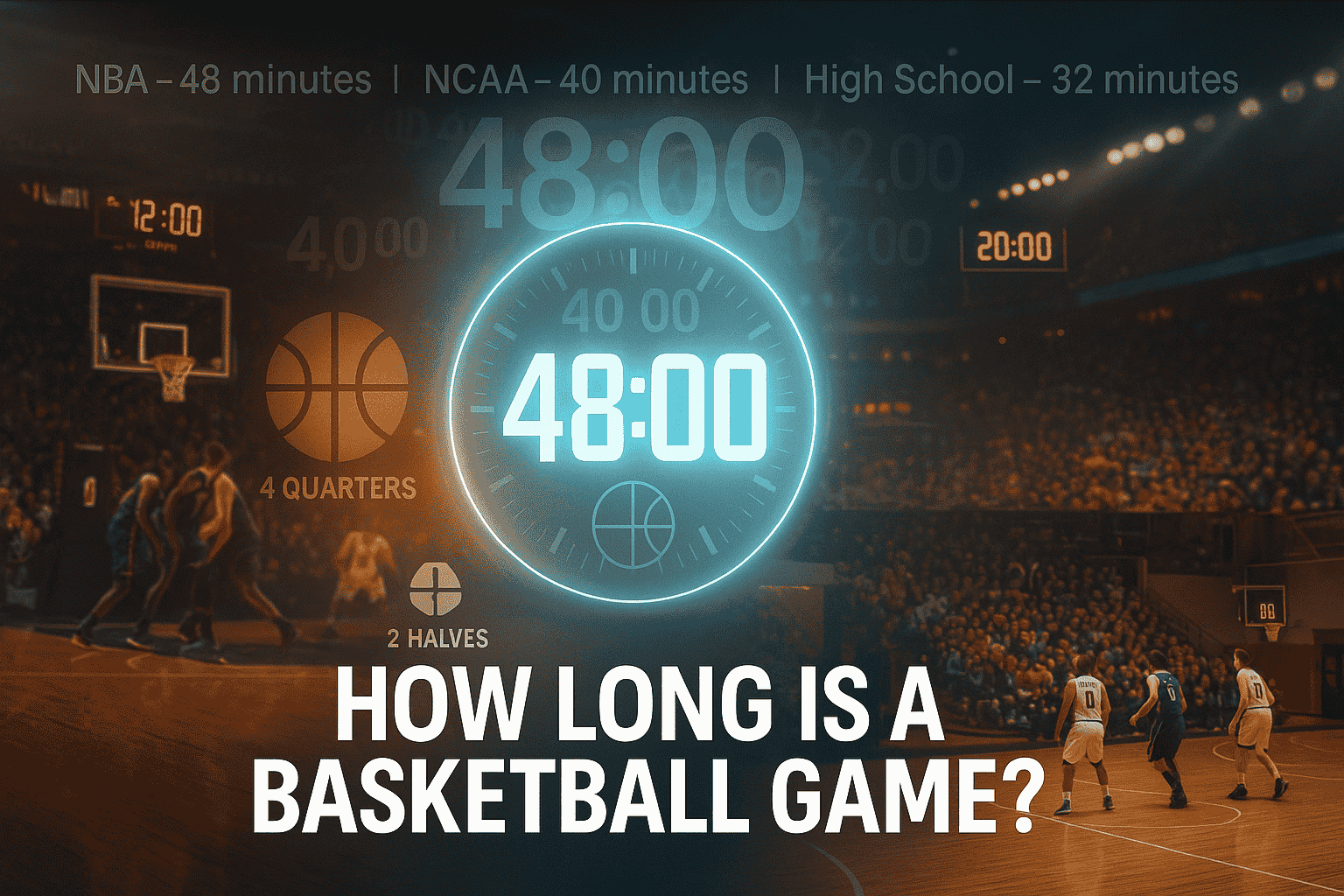
Basketball game duration varies significantly depending on the level of play you’re watching. Whether it’s an NBA showdown, a college March Madness thriller, or your local high school championship, each has its own timing rules that can make a big difference in how long you’ll be glued to your seat.
Understanding Basketball Game Structure
Basketball games are structured differently across various leagues and levels, but they all share some common elements that determine how long a basketball game actually lasts. The game clock is just one piece of the puzzle – there’s so much more that goes into the total time you’ll spend watching.
Quarter System vs. Half System
The fundamental difference in how long is a basketball game starts with whether the game uses quarters or halves. NBA games are divided into four 12-minute quarters, totaling 48 minutes of game time. However, college basketball takes a different approach entirely.
College basketball games consist of two 20-minute halves, also totaling 40 minutes of regulation play. This might seem like a small difference, but it actually affects the flow and pacing of the game significantly. The quarter system allows for more frequent breaks, which can impact momentum and strategy.
High school basketball typically follows a four-quarter system as well, though the length of each quarter varies by state. Most high schools play four 8-minute quarters, making the total game time 32 minutes. Some states opt for different configurations, but the quarter system remains the most common approach at this level.
Official Game Clock Rules
Understanding how the game clock works is crucial to answering “how long is a basketball game?” The clock doesn’t run continuously – it stops for various reasons throughout the game. Dead ball situations, timeouts, fouls, and out-of-bounds plays all cause the clock to stop.
The shot clock is another timing element that affects game flow. In the NBA, teams have 24 seconds to attempt a shot, while college basketball uses a 30-second shot clock. This difference can significantly impact the pace of play and, consequently, how long the actual game takes to complete.
During the final minutes of each half or quarter, the clock management becomes even more crucial. Teams often employ strategic fouling, which can extend the game considerably beyond its scheduled time. It’s not uncommon for the last two minutes of a close game to take 15-20 minutes of real time to complete.
NBA Basketball Game Duration
NBA games are the gold standard when discussing how long is a basketball game, and they’ve got their timing down to a science. The league has refined its rules over decades to create an optimal viewing experience while maintaining competitive integrity.
Regular Season Game Length
An NBA regular season game consists of four 12-minute quarters, totaling 48 minutes of game time. However, when you’re asking how long is a basketball game in real time, you’re looking at approximately 2.5 to 3 hours from tip-off to final buzzer.
The extended duration comes from several factors beyond the game clock. Each team gets six full timeouts (lasting 100 seconds each) and two 20-second timeouts per game. Additionally, there are mandatory television timeouts that occur at specific intervals to accommodate commercial breaks.
Halftime in the NBA lasts 15 minutes, providing teams with adequate time to rest and strategize. The break between quarters is typically 2 minutes and 10 seconds, though this can vary slightly. When you add up all these elements, plus the natural stoppages for fouls, out-of-bounds plays, and substitutions, the total time extends considerably.
Playoff Game Variations
Playoff games follow the same basic timing structure as regular season games, but they often run longer due to increased intensity and strategic play. Teams tend to use their timeouts more strategically, and the pace of play can slow down as every possession becomes more valuable.
The atmosphere in playoff games also contributes to extended duration. Player introductions are longer, halftime entertainment is more elaborate, and there are often additional ceremonies or presentations. Close playoff games can easily extend beyond three hours, especially if they go into overtime.
College Basketball Game Duration
College basketball presents a different answer to “how long is a basketball game?” The NCAA has its own unique timing structure that creates a distinct viewing experience compared to professional basketball.
NCAA Men’s Basketball Timing
Men’s college basketball games consist of two 20-minute halves, totaling 40 minutes of regulation time. This is eight minutes less than NBA games, but the real-time duration is often comparable due to different timeout structures and game flow.
Each team receives four 75-second timeouts and two 30-second timeouts per game. There are also media timeouts that occur at the first dead ball under the 16, 12, 8, and 4-minute marks of each half. These media timeouts last 2 minutes and 30 seconds each.
Halftime in college basketball is 15 minutes, the same as the NBA. However, college games often feel longer due to the increased frequency of fouls and free throws, especially late in games. The “one-and-one” free throw situation in college basketball (where players must make the first free throw to attempt the second) can extend games significantly.
NCAA Women’s Basketball Timing
Women’s college basketball follows a four-quarter system, making it unique among college sports. Each quarter lasts 10 minutes, totaling 40 minutes of regulation time – the same as men’s college basketball but divided differently.
This quarter system was adopted to align women’s college basketball more closely with international play and the WNBA. The timeout structure is similar to men’s basketball, with each team receiving four 75-second timeouts and two 30-second timeouts per game.
High School Basketball Game Length
High school basketball provides another variation in answering how long is a basketball game, with rules that can vary significantly from state to state.
State Variations in Timing Rules
Most states follow the National Federation of State High School Associations (NFHS) guidelines, which recommend four 8-minute quarters. This creates 32 minutes of regulation time, making high school games shorter than both college and professional basketball.
However, some states have adopted different timing structures. For example, certain states use four 6-minute quarters for junior varsity games, while others might extend varsity quarters to 10 minutes. These variations mean that how long is a basketball game at the high school level can range from 24 to 40 minutes of game time.
Timeout structures also vary by state, but most allow five timeouts per team per game. Some states differentiate between full timeouts (60 seconds) and short timeouts (30 seconds), while others use a uniform timeout length.
Junior Varsity vs. Varsity Differences
Junior varsity games are often shorter than varsity games, both in terms of quarter length and overall structure. Many schools play JV games with four 6-minute quarters, creating 24 minutes of regulation time.
The shorter duration serves multiple purposes: it allows younger players to develop without the physical demands of longer games, provides more opportunities for substitutions and learning, and often fits better into school schedules when JV and varsity games are played as doubleheaders.
International Basketball Game Duration
International basketball follows FIBA (International Basketball Federation) rules, which create yet another answer to how long is a basketball game.
FIBA Rules and Regulations
FIBA games consist of four 10-minute quarters, totaling 40 minutes of regulation time. This is the same total as college basketball but divided into quarters like the NBA and high school basketball.
The timeout structure in FIBA is more restrictive than American basketball. Each team receives two timeouts in the first half, three timeouts in the second half, and one timeout in each overtime period. Timeouts last one minute each.
FIBA’s shot clock is set at 24 seconds, matching the NBA. However, the clock resets to 14 seconds (rather than 24) when the ball hits the rim and the offensive team retains possession.
Olympic Basketball Timing
Olympic basketball follows FIBA rules, meaning games consist of four 10-minute quarters. However, the tournament structure and global audience often result in longer real-time duration due to extended ceremonies and international broadcasting requirements.
The knockout format of Olympic basketball can also lead to more intense games with strategic fouling and timeout usage, extending the actual viewing time beyond the basic game structure.
Factors That Affect Game Length
Several factors beyond the basic game clock determine how long is a basketball game in real time. Understanding these elements helps explain why a 48-minute NBA game takes nearly three hours to complete.
Timeouts and Their Impact
Timeouts are perhaps the biggest factor in extending basketball games beyond their scheduled duration. NBA teams can call six full timeouts and two 20-second timeouts, while college teams have four 75-second timeouts and two 30-second timeouts.
Television timeouts add significant time to broadcast games. These mandatory breaks occur at predetermined intervals and can last anywhere from 2 to 4 minutes, depending on the level of play and broadcasting agreement.
Fouls and Free Throws
Free throw situations naturally extend game duration since the clock stops during foul shots. In close games, strategic fouling can add substantial time, especially in the final minutes when teams try to stop the clock and get the ball back.
The “bonus” situation in basketball (when teams have committed enough fouls to send opponents to the free throw line on any subsequent foul) can significantly impact how long a basketball game lasts. This is particularly noticeable in college basketball, where the one-and-one free throw rule creates additional uncertainty and potential clock stoppages.
Video Reviews and Challenges
Modern basketball includes video review systems that can extend games. NBA games include reviews for flagrant fouls, shot clock violations, and last-second shots. College basketball has similar review protocols, particularly for determining whether shots were released before time expired.
These reviews, while crucial for game integrity, can add several minutes to the total duration. Close games with multiple review situations can extend well beyond typical timing expectations.
Overtime Rules Across Different Levels
Overtime rules provide the final piece in understanding how long is a basketball game. Each level has specific protocols for breaking ties that can significantly extend game duration.
NBA overtime periods last five minutes each, with teams receiving two additional timeouts. If games remain tied, additional overtime periods are played until a winner is determined. Some NBA games have gone to multiple overtimes, creating legendary contests that last well over four hours.
College basketball overtime periods are also five minutes long, but teams receive one additional timeout per overtime period. The intensity of college basketball often leads to multiple overtime games, particularly in tournament settings where elimination is on the line.
High school overtime rules vary by state, but most follow a four-minute overtime period structure. Some states allow for multiple overtime periods, while others have specific tie-breaking procedures after a certain number of extra periods.
International basketball uses five-minute overtime periods, similar to NBA and college rules. However, FIBA’s timeout structure (one timeout per overtime period) can lead to different strategic approaches that might affect game duration.
Frequently Asked Questions
How long does a typical NBA game last in real time?
A typical NBA game lasts approximately 2.5 to 3 hours from tip-off to final buzzer. While the game clock shows 48 minutes (four 12-minute quarters), timeouts, halftime, fouls, and natural game stoppages extend the actual viewing time significantly.
Why are college basketball games shorter than NBA games?
College basketball games have 40 minutes of regulation time (two 20-minute halves) compared to the NBA’s 48 minutes (four 12-minute quarters). However, real-time duration is often similar due to different timeout structures and the pace of college play, which typically includes more fouls and free throws.
Do high school basketball games vary in length by state?
Yes, high school basketball game length can vary by state, though most follow the NFHS recommendation of four 8-minute quarters (32 minutes total). Some states use different quarter lengths or have varying rules for junior varsity versus varsity games.
How long is halftime in different levels of basketball?
NBA and college basketball both have 15-minute halftimes. High school basketball typically has shorter halftimes, usually ranging from 10 to 15 minutes depending on state regulations. International basketball (FIBA) uses a 15-minute halftime period.
What happens if a basketball game is tied at the end of regulation?
All levels of basketball use overtime periods to determine a winner. NBA and college basketball play 5-minute overtime periods, while high school typically uses 4-minute periods. Games continue with additional overtime periods until one team wins.
How do television timeouts affect basketball game length?
Television timeouts can add 15-30 minutes to the total broadcast time of a basketball game. These mandatory breaks occur at predetermined intervals during televised games and typically last 2-4 minutes each, depending on the broadcasting agreement and level of play.
Conclusion
Understanding how long is a basketball game requires recognizing that the answer varies significantly depending on the level of play, game situation, and various external factors. While the game clock provides a basic framework – 48 minutes for NBA, 40 minutes for college, and typically 32 minutes for high school – the actual viewing experience extends well beyond these numbers.
Whether you’re planning to watch an NBA playoff thriller, a college March Madness upset, or your local high school championship, you should expect to invest 2-3 hours of your time. The beauty of basketball lies not just in its timed nature, but in how those crucial seconds can create moments that extend far beyond the clock.
Next time someone asks you “how long is a basketball game,” you’ll be equipped with the knowledge to give them a comprehensive answer that goes beyond just the game clock. From the strategic timeout usage to the excitement of overtime periods, basketball’s duration is as dynamic and unpredictable as the sport itself.